
Bernissartia Dollo, 1881
Meaning
From Bernissart (in Belgium)
Classification
Crocodylomorpha
Bernissartiidae Dollo, 1883
Bernissartia sp. indet. Buffetaut and Ford, 1979
Stratigraphy
Wessex Formation
Lifestyle
This crocodile would have had similar habits to modern piscivorous crocodiles
Description
Known only from teeth, Bernissartia teeth are recognisable by their low, blunt, rounded profile, although some have an obtuse but somewhat pointed apex and resemble the posterior teeth of many crocodiles. The rest, which are presumably more posterior, have a completely rounded, semicircular profile. Some of the larger teeth are hemispherical, and in occlusal view their outline is regularly oval. others are more elongated, or are laterally compressed. Some are even kidney-shaped, with a fairly sharp constriction at the midpoint.
The teeth show a distinct ornamentation of the enamel. On unworn crowns, a longitudinal ridge can be seen, from which fine wrinkles radiate on the sides of the crown. Nearer the base, the enamal becomes more smooth, and only show faint growth rings.
As the tooth wore down, the enamel along the ridge would wear down, producing a shallow, narrow groove cutting into the dentine beneath, and eventually forming a flat wear facet.
It has been suggested that Bernissartia is the same as Hylaeochampsa, but until more is known no comparison can be made
Goniopholis Owen, 1841
Meaning
Angled Scutes
Classification
Crocodylomorpha
Goniopholidae Cope 1875
Goniopholis cressidens Owen, 1841
Stratigraphy
Wessex Formation
Lifestyle
This crocodile would have had similar habits to modern piscivorous crocodiles
Description
Goniopholis is best known from scutes and teeth. The scutes are ornamented with deep pitting, and have an almost “waffle-like” appearance.
Goniopholis can be recognised as it has a slightly brevirostrine skull with the lateral margins of the rostrum festooned both vertically and laterally. There is a notch at the suture between premaxilla and maxilla. There is an undivided external naris positioned near the rostral tip of the snout, and the nasals are excluded from the external naris by the premaxillae and ending slightly caudal to the naris. The orbits are smaller than the supratemporal fenestrae. There is a short lacrimonasal suture, and the ventral surface of the mandible is flat and sculptured at the level of the mandibular symphysis.
Hylaeochampsa Owen, 1874
Meaning
Wood crocodile
Classification
Crocodylomorpha
Hylaeochampsidae Williston 1925
Hylaeochampsa vectiana Owen 1874
Stratigraphy
Vectis Formation
Lifestyle
This crocodilian appears to have been a molluscivore, using it’s button-like teeth to crush the shells of bivalves such as Unio.
Description
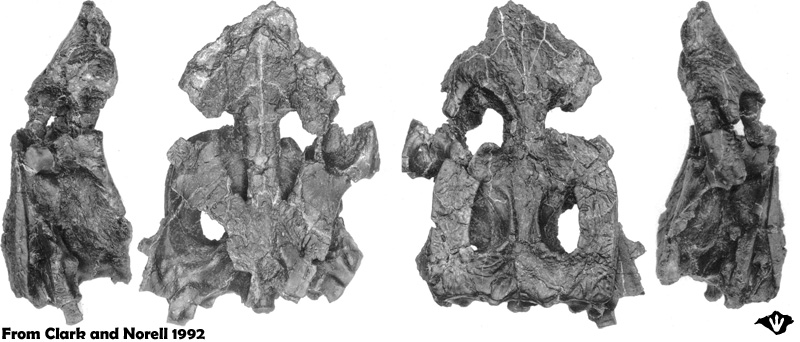
A eusuchian possessing the unique derived features of an extensive ectopterygoid bordering extremely broad posterior maxillary teeth and contacting the palatine anteriorly, a flat surface on the occipital faces of the quadrate and pterygoid, an unusually prominent process on the occipital surface of the paroccipital process medial to the cranioquadrate passage, a vertical posterior wall to the supratemporal fossa, a relatively long skull table with a narrow, elongate supratemporal fenestra, a posterior process of the jugal that is twisted dorsomedially around its longitudinal axis, a short distal portion of the quadrate, and an extremely broad prefrontal pillar. Uniquely possesses the combination of a preorbital constriction, enlarged posterior maxillary teeth, and an apparently short rostrum. Derived characters shared with some Eusuchia (but not necessarily synapomorphic)-prominent boss on ventral surface of quadrate (also in primitive alligatorids), lower temporal bar strongly arched dorsally, posterior ectopterygoid process absent (also in some crocodylids), and palatines very narrow between suborbital fenestrae (also in crocodylids).
It has been suggested that Bernissartia is the same as Hylaeochampsa, but until more is known no comparison can be made.
Oweniasuchus Owen, 1841
Meaning
Owen’s Crocodile
Classification
Crocodylomorpha
Goniopholididae Cope 1875
Oweniasuchus Woodward 1885
Stratigraphy
Wessex Formation
Lifestyle
This crocodile would have had similar habits to modern piscivorous crocodiles
Description
Lorem ipsum dolor sit amet, consectetur adipiscing elit. Ut elit tellus, luctus nec ullamcorper mattis, pulvinar dapibus leo.
Pholidosaurus Owen, 1841
Meaning
Horny-scaled reptile
Classification
Crocodylomorpha
Neosuchia Benton and Clark, 1988.
Pholidosaurus meyeri (von Koken, 1887)
Stratigraphy
Wessex Formation
Lifestyle
This crocodile would have had similar habits to modern piscivorous crocodiles
Description
Lorem ipsum dolor sit amet, consectetur adipiscing elit. Ut elit tellus, luctus nec ullamcorper mattis, pulvinar dapibus leo.
Theriosuchus Owen, 1841
Meaning
Beast crocodile
Classification
Crocodylomorpha
Atoposauridae Gervais 1871
Theriosuchus sp.
Stratigraphy
Wessex Formation
Lifestyle
This crocodile would have had similar habits to modern piscivorous crocodiles
Description
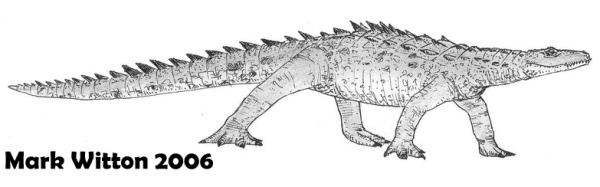
Theriosuchus scutes are less heavily sculptured than Goniopholis, with only a few small circular pits, but have a prominent midline keel.
Vectisuchus Buffetaut and Hutt 1980
Meaning
Vectis Crocodile
Classification
Crocodylomorpha
Goniopholididae Cope 1875
Vectisuchus leptognathus Buffetaut and Hutt 1980
Stratigraphy
Wessex Formation
Lifestyle
This crocodile would have had similar habits to modern piscivorous crocodiles
Description
Piscivorous mesosuchian crocodilian of small size. Slender, moderately elongate snout sharply demarcated from the posterior part of the skull. Nasal bones reaching premaxillae. Orbits large and rounded, facing forwards and sidewards. Supratemporal openings about as large as the orbits. Postorbital pillar somewhat displaced inwards and sloping backwards. Well developed pterygoid wings. Internal nares limited anteriorly by the palatines, but situated mostly in the pterygoids. Mandibular symphysis relatively long, with the splenials taking part in it. Mandible slightly expanded anteriorly, with third and fourth alveoli large and continuous. Long retroarticular processes. Teeth pointed and slender. Vertebrae amphicoelias. Cervical vertebrae bearing well-defined hypapophyses. Dorsal and ventral armour well developed. Dorsal scutes bearing an anterolateral peg and two longitudinal ridges. Ventral scutes hexagonal. Forelimbs long, with all segments elongate and slender, especially the carpal bones.