
The Isle of Wight has been involved in the history of dinosaur palaeontology since 1829, when the first Iguanodon material was described by Dean William Buckland from Yaverland Point, near Sandown.
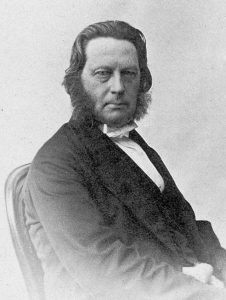
The most famous dinosaur hunter in the history of the Isle of Wight is the Reverend William Fox (1813-1881), who although was not a professional scientist, he was curate at St. Helens church in Brighstone village (then known as Brixton) during the mid-19th century, from 1862 until presumably his death 19 years later, although he was known to be concerned that his position in the village was under threat, as he wrote several letters to his good friend Sir Richard Owen (1804-1892), who even contacted William Gladstone, the then Prime Minister, to try and keep Fox in Brighstone, but sadly failed.
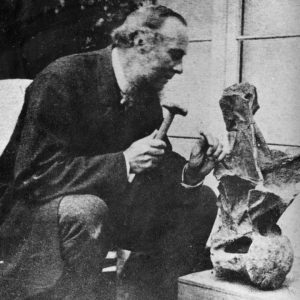
Fox, who was aquainted with the likes of John Hulke (1830-1895) and Richard Owen, had easy access to Brighstone Bay from his home, Myrtle Cottage in Brighstone, and so spent many an hour collecting fossils, much to the detriment of his parishioners; in fact, it was said of him at the time, by the wife of the vicar, that it was “always bones first and the parish next”. He is also quoted as having written in a letter to Sir Richard Owen “I cannot leave this place while I have any money left to live on, I take such deep [sic] in hunting for old dragons”, making it quite obvious this was a man obsessed. It was this devotion to fossil hunting that has made him an example of the vital role played by amateur palaeontologists not only on the island, but all over the world, which has carried on to this day, and it is due to this that he is the Englishman who has had more dinosaurs named after him than any other.
Fox was the finder of Aristosuchus, Calamospondylus, Hypsilophodon and Polacanthus, the last three actually getting their species name from him, as Fox preferred for his discoveries to be described by professional scientists so the rules of scientific nomenclature allow it.
The earliest reference to possible dinosaur tracks on the Isle of Wight was in 1854, when Beckles commented on tridactyl structures at Bonchurch, near Ventnor, but there are no known reptile tracks above the Vectis Formation on the island, or at least haven’t been reported since, although Gideon Mantell (1790-1852) dismissed the footmarks mentioned above as being of non-vertebrate origin in 1854. Samuel Beckles (1814-1890) described less controversial dinosaur footmarks in 1851, also tridactyl and presumably Iguanodon, on the southwest coast of the Isle of Wight between Brook and Brighstone.
Isle of Wight dinosaurs became very neglected in the first half of the twentieth Century, indeed no new species were found until 1996, with Neovenator. The only real studies done were by Reginald Hooley (1886-1923), who not only described remains of Iguanodon but also the pterosaur Ornithodesmus, which has since been renamed Istiodactylus, and some time after by William Swinton (1900-1994), who discussed the anatomy of Hypsilophodon and the nature of the whole dinosaur fauna.
The Isle of Wight’s dinosaurs burst back into scientific world in the late Sixties with the publishing of several papers by Peter Galton, with his work on Hypsilophodon, and work done by William Blows on dinosaur footprints and Polacanthus. This and a general growth in interest in dinosaurs brought on by Robert Bakker’s theories on warm-bloodedness in theropods, brought about a whole new interest in the Isle of Wight, which was increased when the Phillips family found the remains of a Eucamerotus on their land in 1992, which was followed nicely by the release of Jurassic Park, which did for dinosaur studies what Dante’s Peak did for vulcanology and Jaws did for oceanography. With work being done on the island by local palaeontologists as Steve Hutt, Dave Martill and Darren Naish, the Isle of Wight is once again being recognised as being a dinosaurian treasure-trove.
The sudden interest in the island’s dinosaurs lead to the opening of several museums on the island, the earliest being the Phillips family’s Dinosaur Farm which opened in 1992 (now Dinosaur Expeditions) and Dinosaur Isle opened its doors in 2001, having relocated its material from the old Museum of Isle of Wight Geology above the Sandown library, which opened in 1913.
MARTILL, D. M., NAISH, D. and HUTT, S. 2001. Introduction.In MARTILL, D. M. and NAISH, D (eds). Dinosaurs of the Isle of Wight. The Palaeontological Association. Field Guide to Fossils 10.11-24.