
Meaning
High-Ridged Tooth
Length
2 metres (6 foot)
Classification
Ornithopoda,
Hypsilophodontidae Dollo, 1882
Hypsilophodon foxii Huxley, 1869
Locations
Brighstone Bay, in the aptly named Hypsilophodon beds. This is a bed a short distance west of Barnes High, just below a bed of White Sandstone. They are found in 1 metre (3½ feet) of mottled red and blue clay.
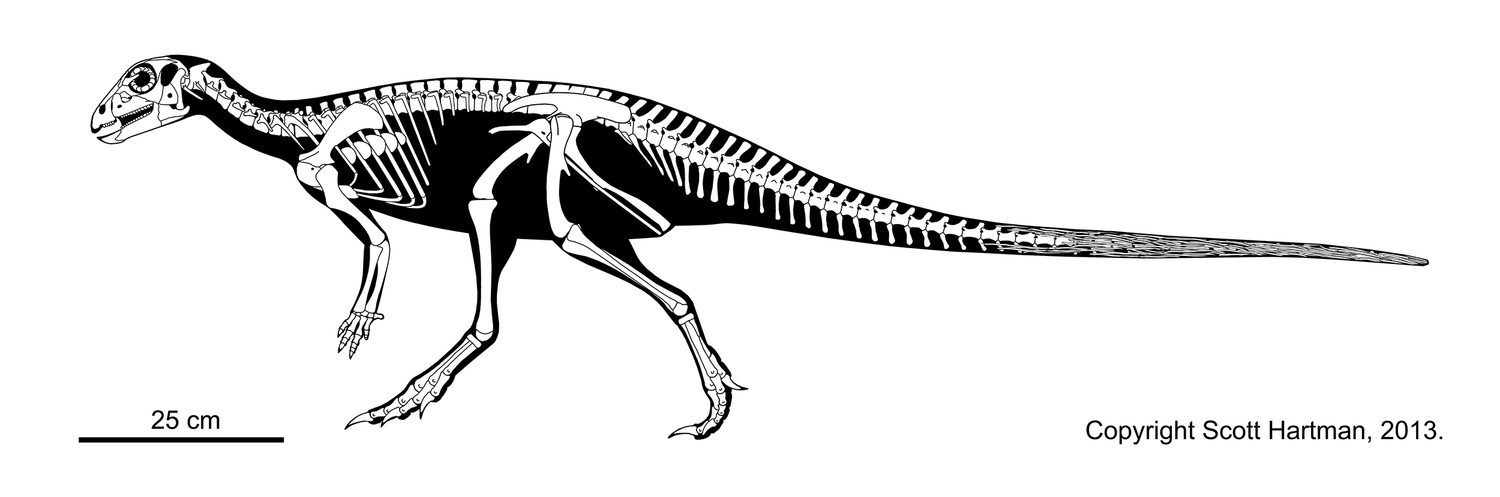
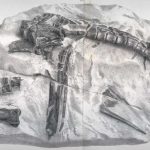
A small ornithopod dinosaur, it was originally believed by scientists to be arboreal, using its fourth toe to hold onto branches in a similar manner to the hallux of a bird. Later study in the 1970’s showed this to be unlikely, and Hypsilophodon is now believed to have lived a gazelle-like lifestyle, feeding on the ferns and cycads, running away when attacked by predators.
It is also believed to have lived in herds, as remains of nearly 100 Hypsilophodon skeletons have been found in the Hypsilophodon beds.
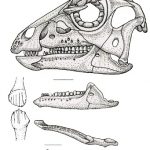
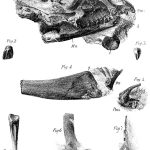
Hypsilophodon has five premaxillary teeth separated by step from maxillary row with 10 or 11 teeth, 13 or 14 on dentary. The enamelled medial surface of a dentary tooth has a strong central ridge that is absent on the lateral surface of a maxillary tooth. The narial openings are completely separated by anterior process of the premaxillae. The maxilla features a large antorbital recess or depression plus a row of large foramina. The jugal does not make contact with the quadrate. A large fenestrated quadratojugal borders the lower temporal opening.
Hypsilophodon has five or six sacral ribs, the additional one borne on the anterior part of the first sacral vertebrae. The scapula is the same length as the humerus. There is an obturator process on the middle of the ischium. The femur is recognised by the following combination of characters; fourth trochanter on proximal half, lesser trochanter triangular in cross section with a shallow cleft separating it from the greater trochanter, practically no anterior condylar groove and posteriorly outer condyle almost as large as inner. The femur can be distinguished from Valdosaurus as Hypsilophodon has a straight femur, as opposed to a curved one. The foot has a well-developed hallux, which lead to the misinterpretation about lifestyle.
GALTON, P. M. 1974. The Ornithischian Dinosaur Hypsilophodon from the Wealden of the Isle of Wight. Bull., Brit. Mus. Nat. History. 152pp.
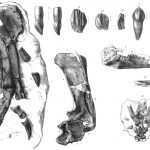
HULKE, J. W. 1882. An Attempt at a Complete Osteology of Hypsilophodon Foxii; a British Wealden Dinosaur. Philosophical Transactions of the Royal Society of London, 173, 1035-1062.
NAISH, D. and MARTILL, D. M. 2001. Ornithopod dinosaurs. In MARTILL, D. M. and NAISH, D (eds). Dinosaurs of the Isle of Wight. The Palaeontological Association. Field Guide to Fossils 10. 60-132