
Meaning
Wight clavicle
Length
3 metres (10 ft)
Classification
Sauropterygia Owen, 1860
Plesiosauriade Blainville, 1835
Leptocleididae White, 1940
Vectocleidus pastorum
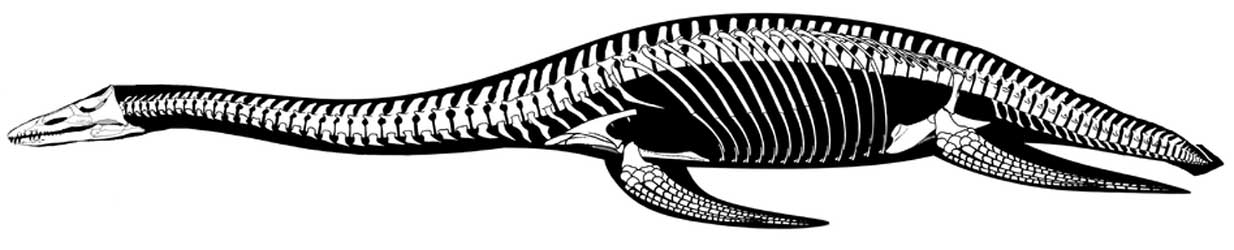
Unusually for a plesiosaur, Vectocleidus occurs in lagoonal or shallow marine inshore areas, though it may have frequented freshwater environments such as lakes and rivers as well. It was a generalist predator, capable of capturing active prey, or using twist feeding to tear flesh from a large carcass.
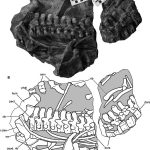
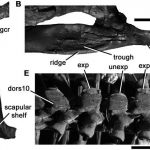
Leptocleidid plesiosaurian with autapomorphic dorsal neural spines that are anteroposteriorly short, and successive spines alternate between being transversely compressed, and being expanded to the right. V.ectocleidus additionally differs from Leptocleidus superstes in having more gracile clavicles and the anterior process of the coracoid is inflected anterolaterally. The posterior cervical centra are shorter anteroposteriorly than high dorsoventrally, differing from Brancasaurus
If rough comparison with the Leptocleidus superstes at the Natural History Museum is accurate, Vectocleidus was nearly 50% smaller, making it the smallest leptocleidid on record!
BENSON, R. B. J., KETCHUM, H. F., NAISH, D., TURNER, L.E., 2013. A new leptocleidid (Sauropterygia, Plesiosauria) from the Vectis Formation (early Barremian–early Aptian; early Cretaceous) of the Isle of Wight and the evolution of Leptocleididae, a controversial clade. Journal of Systematic Palaeontology 11, 233–250.
O’KEEFE, F. R. 2001. A Cladistic analysis and taxanomic revision of the Plesiosauria (Reptilia: Sauropterygia). Acta Zoologica Fennica, 213, 1-63.
CRUIKSHANK, A. R. I. 1997 A lower Cretaceous Pliosauroid from South Africa. Annals of the South African Museum, 105, 206-226