
Meaning
Mantell’s reptile
Length
7 m (23 feet)
Classification
Ornithopoda,
Iguanodontidae Cope, 1869
Mantellisaurus atherfieldensis (Hooley, 1925)
Locations
Mantellisaurus was originally found at Atherfield Point, near Brighstone Bay. The best bet is to look in the plant debris beds, which are usually light grey, with bits of black lignite in them.
Mantellisaurus was a herbivorous dinosaur, feeding on the plants, such as conifers, cycads and tree-ferns that are found in the Wessex Formation.
It has been noted that Mantellisaurus is both quadrupedal and bipedal, although trackway evidence suggests it favoured the former.
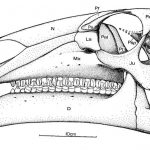
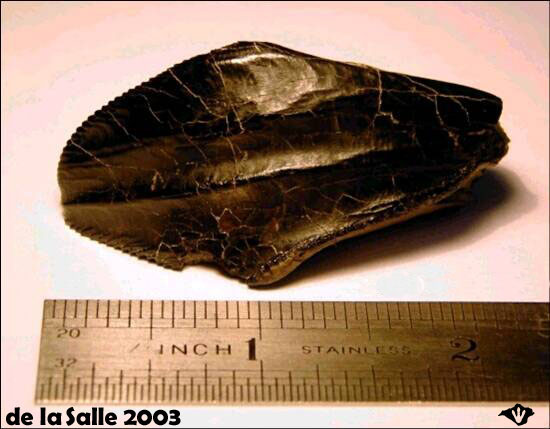
The teeth can reach up to 40 mm (1½ inches) in height, and show an expanded crown and fine denticulation. The teeth of different jaws have different wear marks. On the upper jaw there is a prominent keel in the labial (outer) surface, where as in the lower jaw the teeth have two less prominent ridges on the lingual (inner) surface. To simplify matters, this genus will be described twice, once for each species.
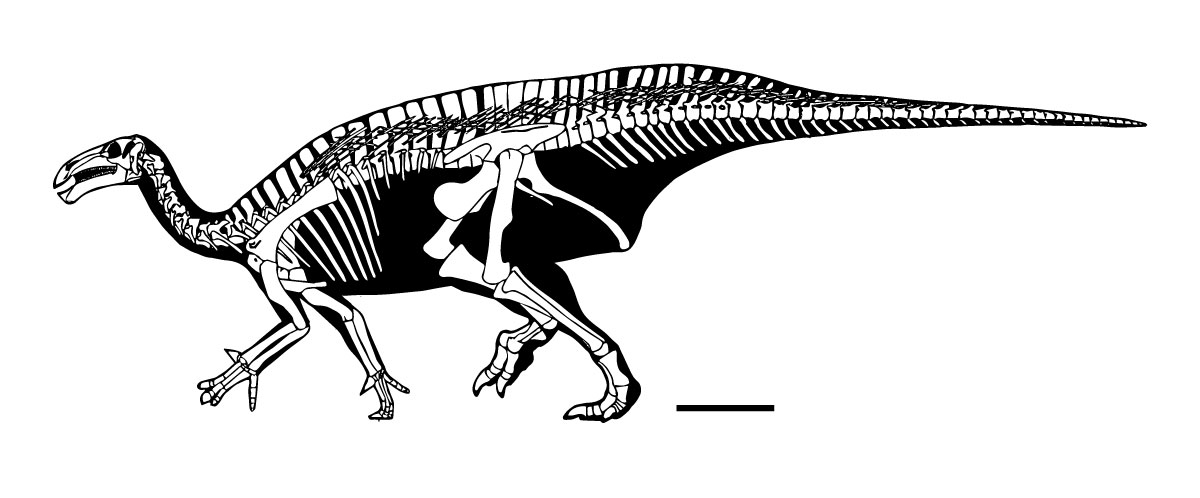
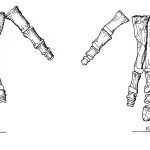
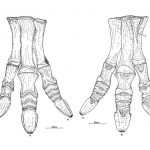
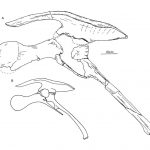
Mantellisaurus has a low skull, with a low angle to the articulation between the dentary and predentary. A rostrally expanded beak gives it, when viewed from above, an hourglass shaped head. Mantellisaurus had a short thumbspike and elongate, gracile metacarpals. There were 3 phalanges in the forth and fifth digits. The forearms were only 50% of the length of the hindlimbs.
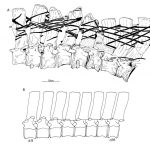
The neural spines were fairly tall, with ossified tendons arranged along them, and there may have been a ridge along the back
NAISH, D. and MARTILL, D. M. 2001. Ornithopod dinosaurs. In MARTILL, D. M. and NAISH, D (eds). Dinosaurs of the Isle of Wight. The Palaeontological Association. Field Guide to Fossils 10. 60-132
NORMAN, D. B. 1986. On the Anatomy of Iguanodon atherfieldensis (Ornithischia: Ornithopoda). Bull. Inst. r. Sci. nat. Belg.: Sciences de la Terre, 56, 281-372.
PAUL, G. S. 2006. Turning the old into the new: a separate genus for the gracile iguanodont from the Wealden of England; In CARPENTER, K. (ed.), Horns and Beaks: Ceratopsian and Ornithopod Dinosaurs. Indiana University Press, Bloomington. 69-77