
Meaning
From Yaverland
Length
90 cm (3 feet)
Classification
Theropoda,
Maniraptora, Gauthier, 1986
Yaverlandia bilothus Galton, 1971b
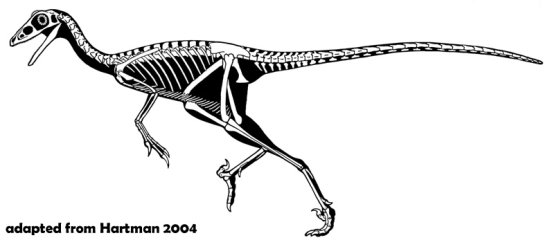
A small maniraptoran theropod, Yaverlandia would have hunted small creatures, such as mammals, lizards and insects. It almost certainly had feathers.
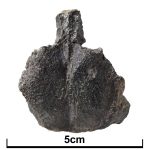
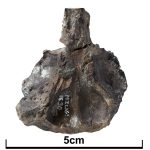
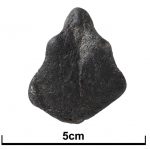
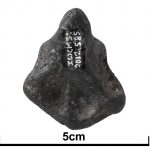
Yaverlandia is known from two partial skull roofs, comprising both frontals and parts of the right postorbital and left orbitosphenoid. The frontals are thickened, albeit mildly compared to most pachycephalosaurs, and display low “domes”. The frontal is not excluded from the edge of the orbit by the prefrontal, and the supratemporal fenestra is not constricted to any extent by the postorbital. The dorsal surface is pitted, especially rostrally. However, Yaverlandia lacks shared-derived features in common with pachycephalosaurs, and most people who examine the material have noticed this. Recent work has shown Yaverlandia to be a maniraptoran theropod, more specifically a troodontid.
NAISH, D. and MARTILL, D. M. 2001b. Boneheads and horned dinosaurs. In MARTILL, D. M. and NAISH, D (eds). Dinosaurs of the Isle of Wight. The Palaeontological Association. Field Guide to Fossils 10. 133-146.
NAISH, D. 2011. Theropod dinosaurs. In Batten, D. J. (ed.) English Wealden Fossils. The Palaeontological Association (London), pp. 526-559.